In Q2 2026, McDonald’s U.S. comparable sales rose just 0.8% as fewer customers came in. At its investor day in September, the company warned that industry traffic would likely stay flat for as long as inflation stays high. In the same economy, Burger King’s U.S. comparable sales jumped 8.5%. McDonald’s says its prices are now below its rivals’, and traffic still fell.
It is not a one-quarter problem. For three years, higher average checks have often done more of the work than more visits.
McDonald’s U.S. sales growth has often relied on higher average checks
U.S. comparable sales by quarter, year over year, with the guest-count direction each earnings release reported. Guests rose in 4 of 14 quarters, fell in 4, and were not stated in 6.

The economy and affordability still matter. But what else is keeping people away?
Part of the answer comes from an unlikely place: a traffic puzzle from 1967.
The Shortcut That Slows Everyone
That year, German mathematician Dietrich Braess got curious about how drivers pick their routes. His answer seemed impossible: on a crowded network, adding a new road can make every trip slower. Each driver takes the fastest route, a new shortcut looks fastest to everyone, and so the shortcut becomes the new bottleneck. Every driver makes a sensible choice, and the system as a whole gets worse.
He published it in 1968. On Earth Day in 1990, New York closed 42nd Street, a crosstown street that is always jammed. Many predicted chaos. Instead, traffic flowed better.
The lesson is that in a busy system, what you remove matters as much as what you add. A new road only helps if there is room for it to flow.
McDonald’s U.S. business may have reached that point.
A Machine Built for Rush Hour
McDonald’s built its business by creating new demand. Breakfast began when a franchisee, Herb Peterson, wanted a reason to open before noon. He designed a Teflon ring so a fresh egg could cook on the same grill as the burgers. The Egg McMuffin went national in 1975, and by 1981 breakfast made up about 18% of sales. McCafé repeated the feat in 2009. It was built for the drive-thru, not the coffeehouse, and coffee grew from about 2% of U.S. sales to more than 6% in the years that followed. Each platform created sustained demand, and each fit a kitchen where every item is built to be assembled in seconds, because the line moves only as fast as its slowest item.
Rivals have learned how hard that is. Wendy’s tried breakfast three times before it went national in 2020. Six years later, breakfast is about 5% of its sales, and franchisees can now cut their morning hours. Taco Bell launched breakfast in 2014 with the biggest marketing campaign in its history. A decade later, it let franchisees drop breakfast altogether. Both chains still serve it in most restaurants. But for each, breakfast became an option. For McDonald’s, it became a habit: sustained demand that is still a core part of the day five decades later.
From Platforms to Promotions
A platform creates or deepens an occasion that repeats beyond the launch campaign. A promotion gives customers a timely reason to act. A promotion can start a habit, but its first sales spike cannot tell us whether one has formed.
Lately, McDonald’s has sounded less sure of itself. On the second-quarter call, CEO Chris Kempczinski said “our restaurant teams were overwhelmed by too many deployments in the quarter.” Service slowed, satisfaction fell, and marketing fell short.
The next platform has been harder to find. All Day Breakfast came close in 2015 but was pulled in 2020. A crispy chicken sandwich, later renamed McCrispy, followed in 2021, and McCrispy Strips built on it in 2025. McCrispy could build a durable chicken habit within lunch and dinner. The question is whether it wins more visits or spending, rather than shifting orders from other items. Breakfast is a useful precedent, but a new platform need not create an entirely new daypart.
Hype has filled the gap, and McDonald’s is very good at creating it. Placer.ai estimated that the Snack Wrap’s 2025 return lifted launch-day traffic 15% above its year-to-date daily average. A KPop Demon Hunters tie-in drove the busiest week of early 2026. Promotions can also lift traffic beyond a single launch day. In Q4 2025, McDonald’s reported growth in both U.S. checks and guest counts, primarily from successful marketing promotions. By Q2 2026, guest counts were falling again. That does not erase the earlier gain, but it leaves the question of how much demand lasts beyond the campaign. Management put it plainly: it is hard to build awareness while “jumping around” between short offers. Hype wins attention. Habits give people a reason to come back.
Why the Easy Road Won
Many platform ideas are good. The hard part is that the cost is certain and paid upfront, in equipment, training and kitchen changes, while the demand is uncertain and arrives later, if at all.
I learned this firsthand when I ran my own coffee shops. We launched a line of sliders. Each crew member needed about 20 hours of training before launch. After launch, problems surfaced in the kitchen. The setup had to change, hold times needed updating and the prep had to be reworked, and everyone was retrained for about 10 more hours. All of that was spent before we knew whether customers would come back for them. We kept the sliders on the menu, but it took almost six months to sort out the issues. That was one line in a small business. A national rollout multiplies that cost across every crew, every shift and every rush.
A platform also has to create a new occasion without slowing the old ones. All Day Breakfast showed the cost: sales jumped, then the kitchen jammed. CosMc’s showed it too, since its drinks needed stores of their own.
A variation on the core is far easier: a new burger on the same patty, a new sauce on the same chicken, a movie tie-in in the same Happy Meal box. These ride on what the kitchen already does, so they launch fast and show up in next month’s sales. McDonald’s appears to have taken this easier route for several years. Each launch made sense on its own. Together, they risked adding more work than the kitchen could carry. Management’s account supports that capacity problem, though it does not establish how much of the traffic decline it caused.
Those extra steps do not cost everyone the same. In a franchised system, the cost of complexity and the reward of simplicity land in different places.
Who Pays for the Launch
About 95% of McDonald’s restaurants are franchised. The company earns mostly rent and royalties, calculated on sales. Franchisees pay for the labor, food and running of each restaurant. So a higher check protects McDonald’s even when fewer people come in. In the second quarter, total franchised margins, which include international markets, rose about 4.3% to $3.71 billion, roughly 90% of restaurant margin dollars.
Operators see the other side. A launch can add preparation, training and assembly work, while fewer guests spread fixed costs thinner. Profit can fall faster than sales. In a National Owners Association survey of more than 100 franchisees, 95% said store profits fell in the first quarter of 2026. That is a limited sample, and it does not isolate the cost of launches. The same leverage works in reverse. McDonald’s says its restaurant program should lift efficiency by about 250 basis points, worth roughly $100,000 a year for the average U.S. restaurant. Those are gross efficiency gains, some of which will be reinvested. A simpler kitchen with returning traffic could push operator profit up faster than sales.
For the people planning the calendar, the lesson is to put the cost of delivering a launch beside the cost of advertising it. Training, waste and service time belong in the decision, even when they sit in someone else’s budget.
Making Room
Braess’s lesson is that sometimes a road has to close before traffic can flow. For McDonald’s, that can mean saying no to a limited-time offer so crews can deliver the remaining menu and value offers every time. Management deserves credit for starting down that path, and for naming the problem. For the rest of 2026, it is reworking the launch calendar so crews can keep up, moving marketing behind Extra Value Meals and cutting non-customer tasks from restaurant routines.
That should help the kitchen and the franchisee. There is a trade-off. Promotions are part of how every fast-food chain stays in the conversation, and lately they have been doing much of the work at McDonald’s. Fewer launches may mean fewer spikes, while better service can make existing visits more satisfying and profitable. Making room gives the business a chance to deliver its promise. The next task is deciding where that promise needs to improve.
The Hard Road
The hard road starts with the core, and the core at McDonald’s is the burger. The last two real upgrades were fresh beef in the Quarter Pounder in 2018 and the “best burger” changes completed in early 2024: softer buns, more Big Mac sauce, meltier cheese and more than 50 other tweaks. The early evidence suggested they worked. In markets that got the changes first, Loop Capital’s contacts reported a lift of about 10% in burger transactions, an informal estimate rather than company data, and Kempczinski said customers were “really noticing.” The Big Arch, introduced in the U.S. in 2026, adds a larger burger, but its sales need to be judged after allowing for orders shifted from the existing menu, and it does not replace the work of improving the classics. The core needs the same steady attention as any launch, because it is what most customers come for.
Growth could also come from a new platform, but that path is less clear. In May 2026 McDonald’s added six specialty drinks, and it has not yet said how they are performing. Drinks look simple, but customization changes everything: a refresher with cold foam and a flavor shot takes far more steps than a soda poured in seconds. Starbucks cut about 30% of its menu in 2025 and pulled back on highly customized drinks, saying the menu had become overly complex. Customization is complex enough that 7 Brew built an entire business around handling it, as we explain in our analysis of 7 Brew. Drinks could win an afternoon occasion, so they are worth testing, but they should expand only if they bring customers back without slowing the line.
McDonald’s has failed that test before. In the early 1990s it put pizza in, by some estimates, nearly 40% of U.S. restaurants. Franchisees remodeled kitchens for new ovens and widened drive-thru windows to fit the boxes. The ovens were meant to bake a pie in under six minutes; in Canada, where pizza lasted longest, the company later put the real time at about 11. Customers wanted pizza. The kitchen could not make it fast enough.
That is the real bar for the next platform. It has to create a reason to visit that repeats, or add to the visits customers already make. It has to complement the core. And it has to fit a kitchen built for speed. Breakfast passed all three tests. Pizza failed the last one. Drinks, chicken or whatever comes next will be judged the same way.
What Burger King Shows
Burger King grew without a new platform. Under its Reclaim the Flame plan, a turnaround now budgeted at up to $700 million, it fixed operations, remodeled stores and sharpened its value deals. It also fixed its core. In February 2026, it upgraded the Whopper for the first time in nearly 10 years, with a better bun, upgraded mayo and a box to keep it hot. On its first-quarter call, the company said the upgraded Whopper had lifted the burger’s average unit volumes to their highest in more than three years. A better core and smoother operations likely worked together. Comparable sales include price and mix, so the result is not a direct measure of returning visits.
Even so, the point is clear. When the core product drifts from what customers expect on quality and value, nothing else makes up for it. No launch or platform can carry a burger that disappoints, so fixing the core comes first.
Once the core is fixed, a platform becomes the source of incremental growth. It gives customers a new reason to visit that the core cannot provide on its own. Burger King shows how far fixing the core can take a business. McDonald’s own history, with breakfast and coffee, shows what a platform adds on top.
What If It Is the Economy?
The economy may matter more than we think. McDonald’s draws more of its visitors from lower-income households than many rivals do, according to Placer.ai. And the quarter started against last year’s highly successful Minecraft promotion. If guest counts bounce back before the menu gets simpler, that would weaken the claim that complexity is the main cause. It would not, by itself, distinguish economic relief from better value offers or easier comparisons.
The Lesson
Growth in a busy system depends on both the reason to buy and the ability to deliver. Adding can create demand. Taking away can make room for it. McDonald’s has added launch after launch. Simplifying the calendar is a sensible start. What follows should depend on where the customer proposition is weakest.
The harder work is what comes after: making the burger better year after year, and building a platform that passes all three tests. Both pay off slowly. Their cost is certain and comes first; the demand is uncertain and comes later. That is why the easy road keeps winning, and why so few companies take the hard one. McDonald’s has done it before, with breakfast and with coffee.
Any business that has grown busy faces the same choice, whether it is a retailer with a crowded shelf or a software product with a feature for every request. The easy move is one more launch. The harder one is to clear room, improve what customers already come for, and add only what the system can carry. The question for McDonald’s is whether it can make the harder choice again.
The Demand to Margin Outlook
McDonald’s is in the early stages of a turnaround. Management has identified the right problem, but execution has yet to show up in the results.
- Demand creation
- Promotions create short-term spikes, but no new platform has yet become a lasting habit.
- Demand capture
- Brand, reach and long-standing habits still bring people in, but guest counts are falling.
- Margin conversion
- The franchise model is built to turn demand into strong margins. Pressure will stay, though, as kitchens, equipment and restaurants need new investment to keep up.
- What to watch
- Promotions that keep McDonald’s in the conversation without adding work to the kitchen.
- A better core burger and value cues customers notice.
- Gains in speed of service.
- A new platform that brings customers back and becomes a source of incremental sales.
This article is analysis, not investment advice. Figures are from McDonald’s earnings releases, SEC filings and earnings calls unless noted. Placer.ai traffic figures and the National Owners Association survey are third-party estimates.
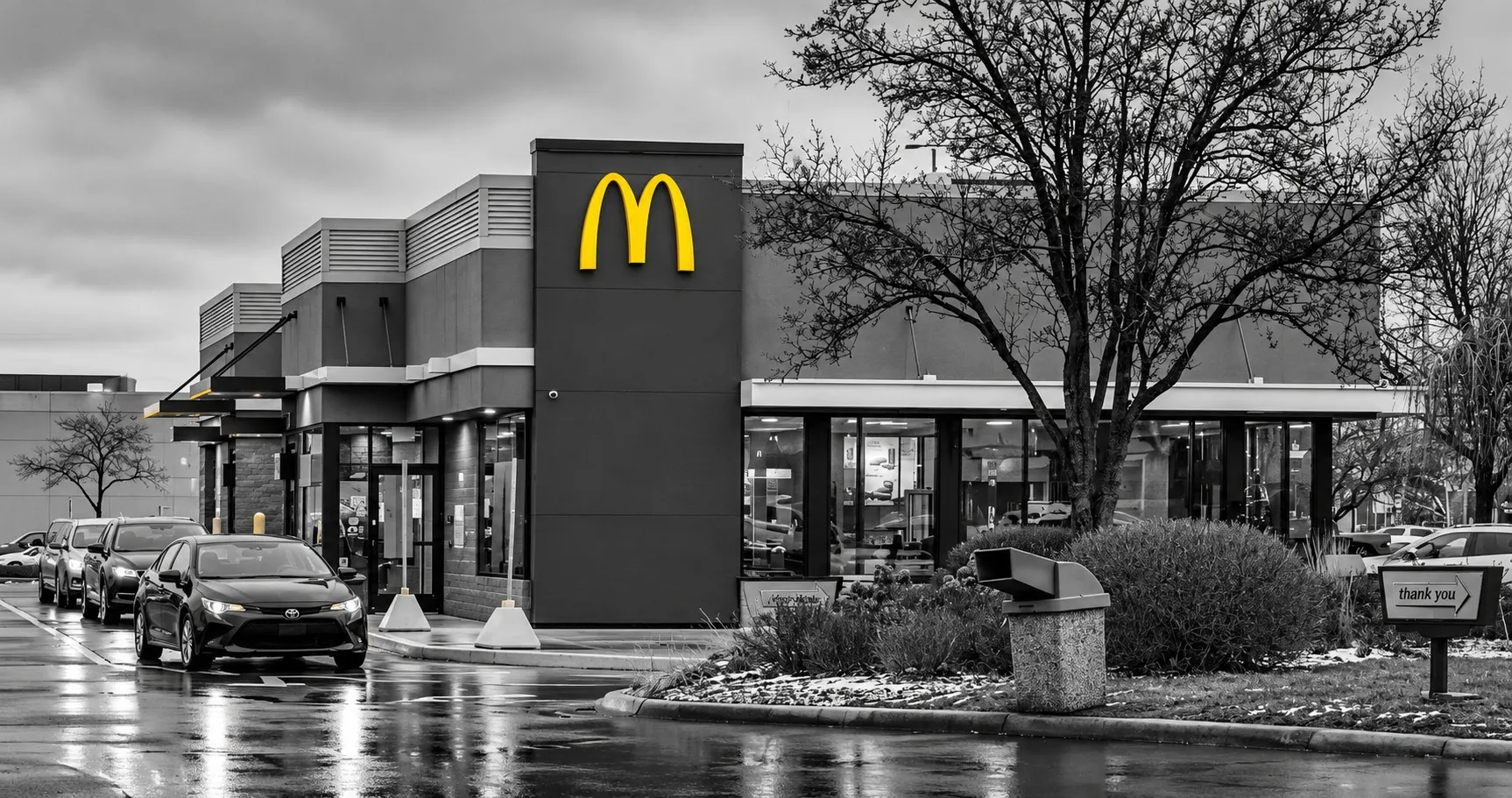
Photo: ajay_suresh, CC BY 2.0, via Wikimedia Commons. Cropped, converted to black and white, sky and foreground altered.
Sources
- McDonald’s Q2 2026 results release, August 4, 2026
- McDonald’s Q2 2026 earnings call transcript, Motley Fool
- McDonald’s investor day release, September 23, 2026
- CNBC, McDonald’s investor day: inflation and traffic, September 23, 2026
- Restaurant Brands International Q2 2026 results release
- Nation’s Restaurant News, Burger King upgrades the Whopper, February 2026
- Restaurant Business, National Owners Association franchisee survey
- CNBC, “Best Burger,” Loop Capital estimate and Kempczinski remarks, February 2024
- Placer.ai, Snack Wrap return and launch-day traffic
- McDonald’s, history of the Egg McMuffin
- C-Store Decisions, McCafé coffee from 2% to more than 6% of U.S. sales
- Fortune, Starbucks cuts 30% of its menu, January 2025
- Restaurant Dive, Wendy’s reviews its breakfast menu, 2026
- Mental Floss, the short life of McDonald’s pizza
- New York Times, December 25, 1990, on closing 42nd Street, via the Tampa Bay Times