One Saturday in the mid-1960s, John Shepherd-Barron arrived at his bank a few minutes too late. The doors were locked. He needed cash, but once the teller windows closed, access to his own money closed with them. Later, his mind wandered to something much simpler: a chocolate vending machine. Put money in, make a selection, and chocolate comes out. No shopkeeper. No opening hours. Shepherd-Barron later described the thought simply: “I hit upon the idea of a chocolate bar dispenser, but replacing chocolate with cash.”
He was in a position to do something about it. Shepherd-Barron was managing director of De La Rue Instruments, part of a British company already deep in the business of money. He took the idea to Barclays and reportedly asked for 90 seconds to explain it. A Barclays executive told him that if he could build such a machine, the bank would buy it. On June 27, 1967, the first machine went into service at a Barclays branch in Enfield, London. Customers inserted a special paper voucher and could withdraw £10 at a time, no more. The important innovation was not what the machine added. It was what it removed. The teller, the banking hall, even the open bank itself had become optional.
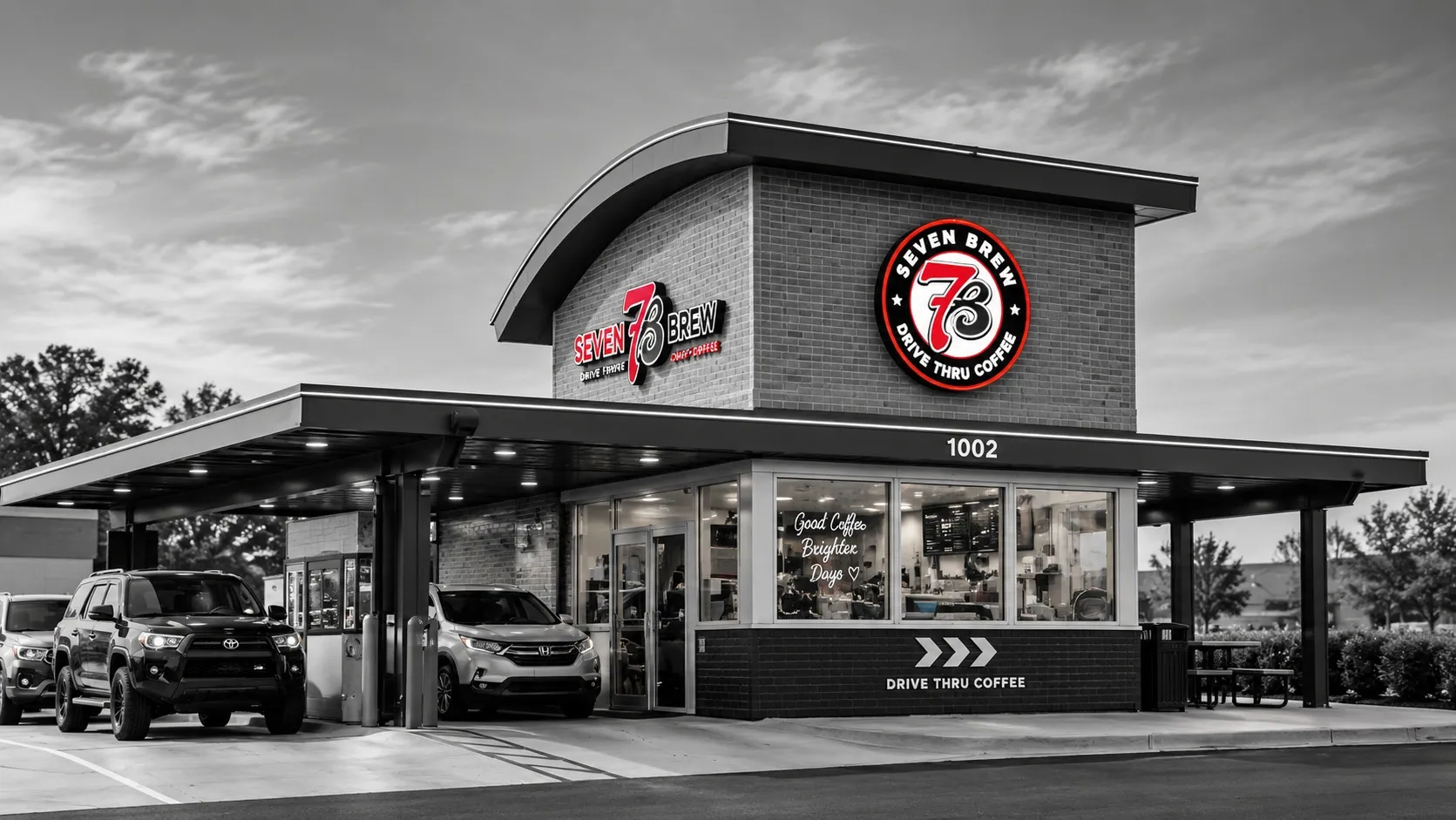
That same logic is what makes 7 Brew interesting. Drive-through coffee stands are not new; Dutch Bros was building them three decades ago. What is new is the speed at which 7 Brew has turned that small box into a growth machine. There is no dining room and almost no café in the traditional sense. What remains is simple: choose a drink, make it quickly, hand it through the window, and move the next car through.
A 7 Brew stand is about 510 square feet, smaller than many one-bedroom apartments. Any franchisor selling in the United States has to publish a Franchise Disclosure Document, the filing a prospective operator receives before signing anything, and it becomes public through state registration. The section covering financial performance is optional, and roughly a third of franchisors leave it blank. 7 Brew fills it in. According to the company’s 2026 document, the 297 franchised stands open for all of fiscal 2025 averaged $2.65 million in annual sales, with median sales of $2.55 million. A year earlier, franchised locations averaged roughly $1.99 million, with median sales of $1.92 million.
That contrast is the heart of the model: a box the size of an apartment, generating revenue that would be respectable for a full-service restaurant five times its footprint, and generating more of it as the system gets larger.
Strong demand alone does not produce that. Plenty of consumer businesses have found a real appetite and then spent the whole of it on serving it. What 7 Brew appears to have built is the harder thing, an engine that carries demand through to margin, by making the part customers pay for more elaborate and almost everything around it cheaper.
The stand is not cheap to build. Depending on the site, the FDD estimates a total initial investment of $940,500 to $2.28 million. But once built, almost everything about the format concentrates on throughput: two drive-through lanes wrap around a small production box, while employees take orders outside and keep cars moving.
Then 7 Brew kept copying the box. It had roughly 600 stands by the end of 2025. By early September 2026 that figure had passed 800 across 38 states, without counting a further 73 sites it has just agreed to buy out of a competitor’s bankruptcy.
The productive small box is only half of the achievement. The other half is a system built to multiply it at extraordinary speed.
Less store, more drink
The physical store is remarkably simple. The drink is not. A customer can start with coffee, an energy drink, tea, lemonade, soda, smoothie or shake, then adjust the flavor, sweetness, milk, caffeine and toppings. 7 Brew says those choices create more than 20,000 possible combinations, drawn from more than 30 syrup flavors alone. Extensive sugar-free options and its own energy drink line pull in customers who might never think of themselves as coffee drinkers.
Customer commentary tends toward a few consistent themes. People mention being able to make a drink exactly as sweet as they want it. They mention sugar-free flavors competitors have dropped, bigger drink sizes, and far more choice than a traditional coffee menu offers. Almost as often, they mention the people serving them: upbeat employees, easy conversation, and a service experience that feels personal for something designed around speed.
Price opinions split. Some customers describe 7 Brew as cheaper than Starbucks for a comparable size; others increasingly say it costs the same or more. What holds across both views is satisfaction with what the spend buys: a large, heavily customized drink, delivered quickly, that feels like theirs rather than an item off a fixed menu.
That flexibility does something useful to the economics of the box. The same 510 square feet can sell an espresso drink on the morning commute, an energy drink after school, a flavored soda to someone who never orders coffee, or a shake in the evening. Complexity has moved out of the store and into the cup.
Customers return because there are thousands of ways for the next drink to feel like theirs.
Complexity in the cup, simplicity around it
Customization is expensive to deliver. Every extra flavor, milk option or sweetness adjustment takes time, and that time shows up twice: more labor hours, slower service. 7 Brew has kept that complexity and built almost everything else around handling it.
A traditional café juggles dine-in customers, counter orders, mobile pickup, delivery, food, and sometimes a drive-through, all at once. 7 Brew has essentially one job: take the order, make the drink, move the car. That single flow can be continuously refined: where ingredients sit, when orders are taken, how staff are deployed, how fast drinks move through the window, all tuned around the same customer journey instead of several competing ones.
The mobile app the company launched in August 2026 shows how firmly that discipline holds, even under pressure to add a channel. 7 Brew added mobile ordering without building a separate pickup infrastructure to support it. A customer can build a drink from the same 20,000-plus combinations ahead of time, but the order is not started until they are actually in the drive-through line, and payment still happens at the window with a Brewista. There is no separate counter, no locker wall, no second queue. The company also says it does not currently use third-party delivery. Even the digital layer gets pulled back into the one physical journey the whole format is built around, rather than becoming a second flow the operation has to manage alongside the first.
The building is small; the site under it usually is not. Two drive-through lanes need room to stack cars, so land requirements for a 7 Brew location commonly run closer to an acre once ingress, egress and stacking are accounted for, well beyond the 510-square-foot structure itself. What 7 Brew has cut is the customer-facing building. The land, if anything, works harder: redirected toward moving traffic through the site rather than housing people inside it.
The margin comes from what the box leaves out
That $6 or $7 customized drink is expensive to produce. Someone has to take the order; multiple ingredients have to be measured and mixed; more customization means more labor time and potentially slower service. 7 Brew has deliberately kept that expensive part, because it is the part the customer values. The margin has to come from somewhere else.
So the company attacks the costs surrounding the drink instead of the drink itself. There is no dining room to clean, heat or staff, no large customer-facing storefront, no separate dine-in queue competing with mobile pickup and drive-through orders. Almost the entire operation is organized around a single customer journey through two lanes.
The trade runs one way and it is deliberate. 7 Brew absorbs the cost of customization by cutting complexity everywhere else. The customer still gets the large, personalized drink; the company never has to build a full café around the transaction to deliver it. Keep spending on what creates demand, and strip cost from everything that does not.
That is the engine in one line. The expensive part stays expensive because it is the part being bought. The margin comes from everything the format refuses to build around it.
The people closest to the numbers are building more
Once the stand economics look attractive, franchising changes the speed of the story. In 2025, 7 Brew required new developers to commit to at least five stores. Its 2026 Franchise Disclosure Document doubled that minimum to 10, with a $125,000 development fee attached to the commitment. A prospective operator is buying the right, and the obligation, to build a small network before finding out whether the first stand works.
The appeal is easy to understand on the numbers alone: franchised stores averaging $2.65 million a year against a total initial investment of $940,500 to $2.28 million for that first store. That is a compelling ratio, even before anyone can say what it implies for store-level profit or payback period, which the disclosure does not provide.
Franchisees supply the capital, develop the sites, hire the teams and run the stands. 7 Brew supplies the brand and the operating system, and collects a royalty as sales flow through the network. A successful box does more than produce sales: it builds the confidence and capital to fund the next ten boxes. That is how good unit economics become a replication machine.
Raising the entry price that way only works if operators keep signing anyway, which makes their willingness to do so the most informative signal available. The people with the closest view of store economics are putting substantially more capital behind the model.
Brew Crew, the chain’s largest franchisee, finished 2025 with 130 locations and $273 million in sales, then borrowed to build more: a $260 million senior secured credit facility with Fifth Third Bank, backing a target of 100 further openings in 2026. An operator sitting on the actual store-level numbers just leveraged up rather than cashed out, which is a real signal about how that operator reads the format’s future.
Flynn Group’s entry reads the same way from a different angle. Flynn operates nearly 3,000 restaurants across brands including Applebee’s, Arby’s, Taco Bell, Pizza Hut and Wendy’s, and had never signed with a brand this young. Its 160-store development deal with 7 Brew, launched under a new division built specifically to scale emerging concepts, is close to a third of the chain’s entire footprint at the time of the announcement. Experienced multi-unit operators have seen most restaurant concepts come and go; a commitment at this scale from one of the largest is a harder signal to wave away than the company’s own enthusiasm would be.
The sharpest proof point came out of someone else’s bankruptcy. In early September 2026, 7 Brew won a court auction for 73 former Salad and Go locations, agreeing to pay $143.2 million and outbidding Dutch Bros, whose own initial offer had been $105 million for 65 sites. The deal still needs a bankruptcy judge’s approval, expected September 21. Outbidding a well-capitalized rival for someone else’s shuttered drive-through real estate is close to a literal demonstration that the valuable asset in this category has become the drive-through box and the site around it, rather than the traditional café that used to sit on land like that.
Salad and Go also supplies the right caution. It ran its own stripped-down drive-through format, expanded aggressively, and ended up in bankruptcy anyway. None of which forecasts the same ending for 7 Brew. It does establish something narrower and more useful: a good format, by itself, guarantees nothing. The box only works if the demand inside it stays strong enough to fill it.
How long before someone does this with less friction?
7 Brew’s model rests on one belief: customers will pay for customization, and the business can turn that willingness into margin by designing everything else around delivering it efficiently. That is harder than it sounds. For most food-heavy quick-service brands, more customization means more friction layered onto a kitchen already juggling dine-in, mobile, delivery and drive-through. 7 Brew started from the opposite direction. The operation was built around customized drinks from day one, and most of the infrastructure a traditional restaurant would need was removed to make room for that complexity instead. Customization here is the organizing principle: the stand, the staffing model, the menu and the drive-through flow all exist to deliver personal choice with as little friction as possible.
Demand remains the variable none of that solves. 7 Brew can standardize the stand, refine the process, and recruit more franchisees, and still not guarantee that every new market holds enough customers willing to keep paying for customization, especially as competitors chase the same occasion. The average-unit-volume trend so far runs the other way. Whether it keeps running that way as the system pushes past 800 stands, then presumably past 1,000, is open.
On the evidence so far, 7 Brew is not overbuilding. Unit volumes are rising alongside unit counts, existing franchisees are reinvesting rather than cashing out, and one of the industry’s most experienced multi-unit operators just made its first bet on a brand this young.
Finding the demand was the ordinary part. Plenty of consumer businesses locate a real appetite and still lose it somewhere between the counter and the P&L, where service costs, real estate and operating complexity absorb whatever the customer was willing to pay. 7 Brew built that stretch of the journey deliberately: keep the expensive thing customers actually value, remove nearly everything else, and let a 510-square-foot box carry the difference. The growth is a consequence of that design rather than a substitute for it.
The sharper question is how long the advantage holds. Customization is imitable. So is a small box on a busy road. What is harder to copy is an operation with only one flow through it, built that way from the beginning while competitors carry the dining rooms, mobile counters and delivery queues they added one at a time. The question is not whether someone else will chase the same occasion. It is whether they can reach it without the infrastructure they already own.
7 Brew has shown that consumers do not necessarily need more coffee shop. They may simply want more of their drink, made their way.
Sources
- 7 Brew 2026 Franchise Disclosure Document, Minnesota Department of Commerce filing 9571
- Flynn Group’s 160-store development deal, Restaurant Dive
- Brew Crew’s 2025 results and Fifth Third credit facility, Food On Demand
- 7 Brew’s $143.2 million auction win for 73 Salad and Go sites, QSR Magazine
- 7 Brew’s first mobile app, Restaurant Dive
- 7 Brew and Dutch Bros unit growth compared, QSR Magazine