When Robert Woodruff took over Coca-Cola in the 1920s, he had a simple idea about distribution. Coca-Cola should always be “within an arm’s reach of desire.”
The logic was almost physical. If someone became thirsty, a Coke should be close enough to buy before the impulse disappeared. Put a cooler near the register. A fountain in the cinema lobby. A vending machine down the office corridor. Coca-Cola even introduced its first standardized open-top cooler in 1929.
The product was already desirable. Distribution’s job was to remove the distance between the product and that desire.
For most of the next century, that remained the basic logic of distribution. Supermarkets turned physical proximity into shelf space. Brands paid for the right position because a few feet could separate being noticed from being ignored.
Then shopping moved online, and the shelf became a screen. Search rankings, sponsored results and app placement compressed the distance again. A customer expressed what they wanted, and brands competed to be as close as possible to that intent.
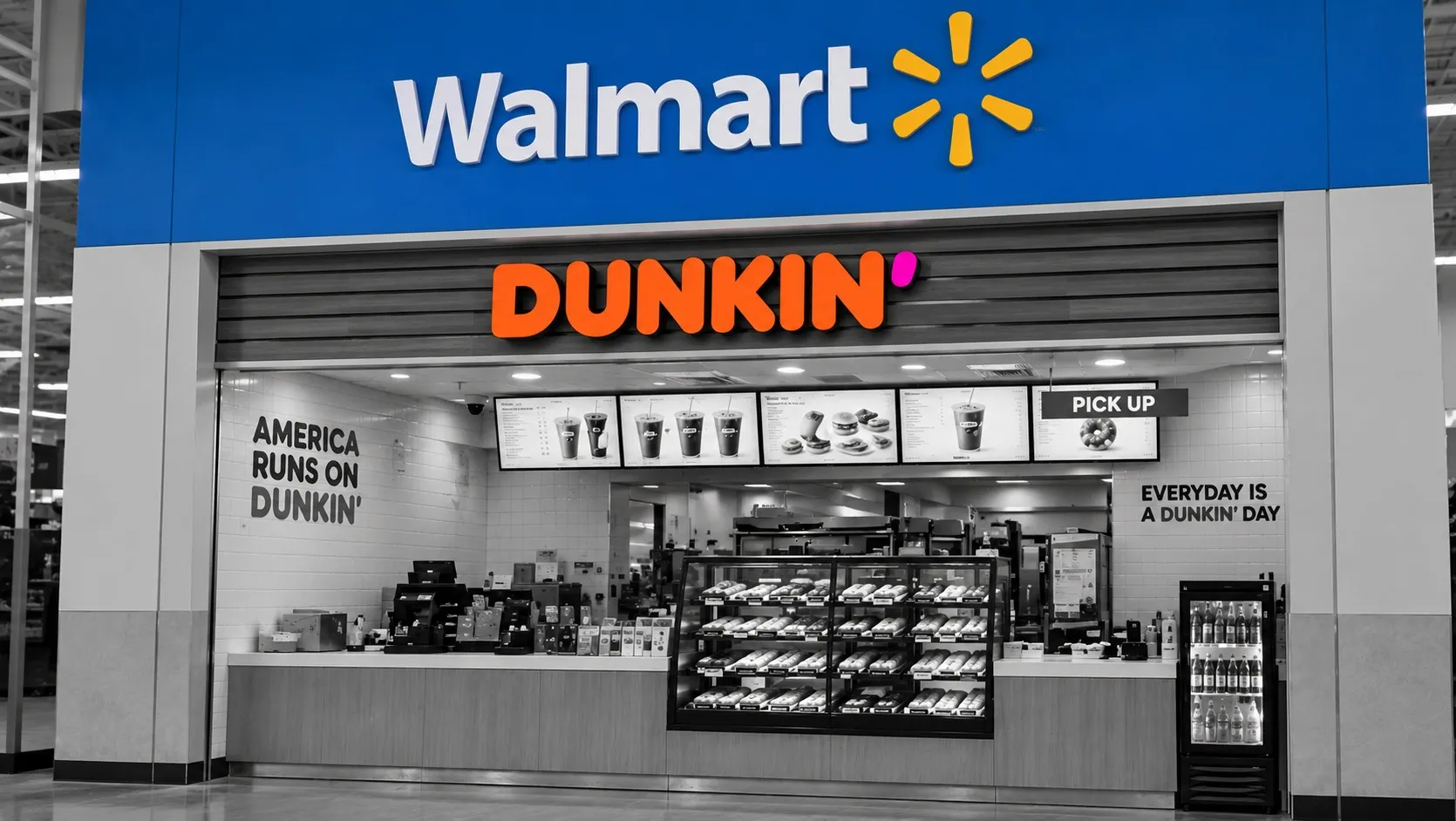
Walmart’s new partnership with Dunkin’ suggests the next evolution may be different. What if the customer did not come looking for coffee at all?
Dunkin’ arrives inside the Walmart app
Walmart and Inspire Brands, Dunkin’s parent company, said that customers can order Dunkin’ beverages and food through the Walmart app and Walmart.com. Eligible customers see a restaurants section, populated automatically according to their delivery address. They browse the menu, customize the order, and pay. Walmart delivers it, using the same last mile network it built for groceries, from stores that sit within ten miles of roughly ninety percent of the United States population.
The rollout starts with about 150 Dunkin’ locations that operate as tenants inside Walmart stores, and both companies say the intention is to extend it to most of Dunkin’s roughly 10,000 American locations. It follows a June 2026 launch with Subway, Walmart’s largest in-store restaurant tenant, which reached all of its 1,400 or so in-store counters by the end of July.
Both companies framed the partnership around reach and convenience.
Read quickly, this is a coffee company gaining distribution and a retailer adding another category. Read more carefully, the asset being monetized is neither coffee nor delivery.
It is the customer intent Walmart already owns.
When intent becomes distribution
Creating demand is expensive. A company has to make someone notice, care, remember and eventually act.
Intent is different. Intent is demand that has already reached the point of action.
When someone opens the Walmart app because they need groceries, diapers or something they forgot, much of that work has already been done. The customer has decided to buy something. They have chosen Walmart. They are ready to transact. That makes the visit valuable far beyond the original shopping list.
Walmart can now ask another question: while you are here, do you want lunch? Coffee? Dinner?
It does not have to make the customer want Dunkin’. It only has to surface Dunkin’ at a moment when buying coffee is plausible. The coffee can ride alongside demand Walmart created for an entirely different reason.
This is different from simply making Dunkin’ easier to find. Traditional distribution removes the distance between a product and existing desire. Walmart can place a product beside desire that began somewhere else.
That is why restaurants are interesting to Walmart. They become another form of inventory that can be merchandised against customer intent the company already owns.
And once a business owns enough recurring intent, the range of things it can distribute becomes much larger than the reason the customer arrived in the first place.
Walmart is building a business on top of the transaction
Once Walmart has the customer’s intent, selling another product is only one way to make that visit more valuable. In its latest quarter, Walmart generated $187.9 billion in revenue. But some of its fastest-growing businesses sit around the merchandise transaction. Global eCommerce grew 23 percent. In the U.S., store-fulfilled delivery grew roughly 43 percent, marketplace sales grew 52 percent and advertising grew 38 percent. Walmart Connect, its U.S. advertising business, grew 43 percent excluding Vizio.
Those businesses reinforce one another. More categories give customers more reasons to use Walmart. More orders make the delivery network denser. As Walmart put more orders onto each delivery route, orders per delivery rose 20 percent. Combined with expedited-order fees and automation, Walmart said in late 2024 that its U.S. net delivery cost per order had fallen roughly 40 percent.
Then there is advertising. Once millions of customers arrive ready to spend, the ability to decide what they see next becomes valuable in its own right. Brands can pay Walmart not only to stock their products, but to influence where they appear during the decision.
That is why Dunkin’ matters beyond the economics of a cup of coffee. Restaurants add another occasion to the Walmart relationship, another transaction that can travel through its network and another category that can eventually be merchandised inside its interface.
Walmart is increasingly monetizing not just what customers buy, but the fact that they came ready to buy something at all.
Walmart is not another aggregator
The strongest objection to all of this is that Dunkin’ did it years ago. Its own site lists Grubhub, Uber Eats, and DoorDash as delivery partners, and its rewards terms already exclude points earned on third-party delivery platforms. Walmart is not the moment the occasion changed hands. Two things still separate it.
The trigger is different in kind. Customers generally arrive at DoorDash with food intent already established: they open the app to buy a meal, then choose Dunkin’ from a list of restaurants. On Walmart, the customer opens an app to buy groceries and is offered Dunkin’ inside an errand.
And Walmart holds every input at once. Traffic, purchase intent, delivery infrastructure, physical stores, payments, membership, and now advertising growing faster than all of it. That combination is what allows Walmart to merchandise competing beverages, restaurants and occasions against each other inside a single interface, which allows Walmart to treat restaurants as merchandisable inventory, not merely as delivery partners.
The transaction is Dunkin’s. The customer journey is Walmart’s.
The terms of this arrangement have not been published, so the question is not what Dunkin’ conceded. It is which parts of the customer’s path through the purchase are decided by Walmart, and what follows from that. Three of them are visible.
Discovery. Walmart decides when Dunkin’ appears. Eligible customers see Dunkin’ surfaced automatically in a restaurants section, populated by their delivery address, inside an interface Walmart designed. A customer can encounter Dunkin’ without having begun with any intention of buying Dunkin’.
Relationship. The customer is logged into Walmart, orders through Walmart and checks out through Walmart. Dunkin’s rewards terms, updated in October 2025, say “points cannot be earned on purchases made through third-party delivery platforms,” and neither company has said whether Walmart orders are treated that way. Either way, the announcements describe no Dunkin’ Rewards integration at all. The mechanism Dunkin’ uses to turn a purchase into a habit has not been described as part of the deal.
Walmart’s loyalty system, meanwhile, is clearly engaged. Its membership fee revenue grew 17 percent globally in the quarter, with record second-quarter net additions, and delivery is the reason people hold Walmart+.
The next purchase. Having served the order, Walmart retains the ability to bring that customer back into the same interface and offer coffee again. Or to offer something else.
What is not known matters as much as what is. We do not know who ultimately controls restaurant pricing, what customer information reaches Dunkin’, or how restaurants will be ranked against each other as Walmart adds more of them.
On pricing there is at least a contrast worth noting. When Subway joined in June, its announcement stated that “pricing is consistent with in-restaurant menus.” Neither Walmart nor Inspire made an equivalent statement for Dunkin’ in September. That proves nothing about what Dunkin’ customers will pay. It leaves a question that a comparable deal answered ten weeks earlier.
These are not minor implementation details. They determine whether Walmart is merely delivering a Dunkin’ order, or increasingly controlling the conditions under which Dunkin’ gets chosen.
Both outcomes look the same at first
Imagine two mornings.
On the first, you wake up wanting Dunkin’. You open the Dunkin’ app, place your usual order and pick it up on the way to work. Walmart has nothing to do with that occasion.
On the second, coffee was never part of the plan. You open Walmart because you need groceries delivered before dinner. Somewhere between milk and paper towels, Dunkin’ appears. You think, I could use a coffee, and add one.
That second cup may be completely new business for Dunkin’. Without Walmart, the purchase might never have happened. Which is why none of this means Dunkin’ has made a mistake.
The harder question is what happens over time. Does Walmart keep creating coffee occasions Dunkin’ never had? Or does the customer slowly learn that the easiest way to get Dunkin’ is simply to wait until Walmart puts it in front of them?
Those two outcomes can look identical in the sales numbers at first. Both produce another Dunkin’ transaction. From the outside there is no way to tell them apart, and nobody has published what would settle it.
The new transaction shows up immediately. The change in who owns the habit may take years to become visible.
The easy numbers answer the wrong question
Now imagine you are the person inside Dunkin’ trying to decide whether the Walmart partnership is working. The easy numbers will arrive first. Orders. Revenue. New customers. Frequency. Maybe even higher sales in markets where Walmart is strongest.
Those numbers matter, but they do not answer the most important question: what kind of demand did the new channel create? A useful measurement plan would separate three things.
First, incrementality. Are Walmart orders happening at different times, on different days, or among customers who were not already frequent Dunkin’ buyers? If they simply replace a drive-thru or Dunkin’ app order, distribution increased but demand did not.
Second, customer behavior after adoption. Once someone starts ordering Dunkin’ through Walmart, do they buy Dunkin’ more often overall, or does more of their existing purchasing migrate into Walmart? The first strengthens the brand. The second strengthens the channel.
Third, where the relationship is accumulating. Is Dunkin’ gaining identifiable customers, loyalty participation and repeat behavior of its own? Or is Walmart gaining the history, frequency and habit while Dunkin’ mainly receives another order?
None of these measures is perfect. But together they are much more useful than asking whether Walmart sales went up.
The danger in platform deals is that the upside appears immediately while the cost, if there is one, develops slowly. Companies can therefore be very precise about what they gained and surprisingly vague about what they may have traded away.
A new channel should not be judged only by the revenue it generates. It should also be judged by who becomes stronger when the customer comes back.
Incremental sales are not the test
That is ultimately what makes the Walmart and Dunkin’ partnership interesting. Dunkin’ can win from this deal. Walmart can win too. Neither requires the other to lose.
A coffee added to a grocery order may be genuinely incremental for Dunkin’. But the same transaction gives Walmart another reason for the customer to stay inside its app, another order moving through its delivery network, and another occasion it can merchandise when that customer returns. The transaction creates value in more than one place.
For a brand, the important question is not simply whether a platform delivers incremental sales. It is where the advantage from those sales accumulates over time.
If the platform disappeared tomorrow, did you gain customers with another reason to choose you?
Or did the platform gain customers with another reason to return to it?
That distinction may barely register in the first year’s revenue. Over enough transactions, it determines who owns the relationship and who increasingly rents access to it. Dunkin’ still makes and sells the coffee. Walmart may increasingly shape the moment in which that coffee gets chosen.
Robert Woodruff wanted Coca-Cola within an arm’s reach of desire. More than a century later, his instruction still holds. But the geometry has changed. Platforms can remove almost all the distance between desire and the product.
The question is whether, in doing so, they create more distance between the customer and the brand.
Sources
- Walmart Expands Restaurant Delivery with Dunkin’, Walmart corporate newsroom, September 3, 2026
- Walmart Expands Restaurant Delivery with Dunkin’, Inspire Brands newsroom, September 3, 2026
- Subway Joins Walmart Express Delivery, Subway newsroom, June 2026
- Walmart Inc. second quarter fiscal 2027 earnings release, quarter ended July 31, 2026
- Walmart Inc. second quarter fiscal 2027 earnings presentation
- Walmart Inc. third quarter fiscal 2025 earnings call transcript, November 19, 2024
- Dunkin’ Rewards Loyalty Program Terms and Conditions, updated October 2025
- Five Things You Should Know About Dunkin’ Delivery, Dunkin’ newsroom