In 1977, Nike had a problem.
The company had already paid for its regular advertising space in Runner’s World. Every month, the formula was fairly simple. Nike had a new shoe. The ad explained what was different about it, how it worked, and why a serious runner should care.
But that month, there was no new shoe.
The page had already been bought. The magazine was going to print. Nike simply had nothing new to sell.
It was an awkward problem for a young company whose founder was not particularly convinced by advertising in the first place. Phil Knight believed more in what Nike called “word-of-foot.” If one runner told another that a shoe was good, that was more powerful than an advertisement.
But Nike still had an empty page to fill.
Its advertising manager, Patsy Mest, gave John Brown, the agency founder working on Nike, an unusually open assignment: make runners feel good about themselves. Brown was not even a runner himself.
What came back looked almost nothing like the shoe advertising Nike had been running. A long country road disappeared into the distance. Far down it was a solitary runner, small enough that you could barely see what he was wearing. No close-up of a shoe. No cushioning technology. No specifications. No price.
The runner was Howard Miller, no model pretending to be an athlete. Years earlier, Miller had become locally known around Seattle for running across the Mercer Island floating bridge to work and back, covering 24 miles a day. Yet Nike deliberately made him almost disappear into the photograph.
The shoe was not the point.
Directly below the image sat five words: There is no finish line.
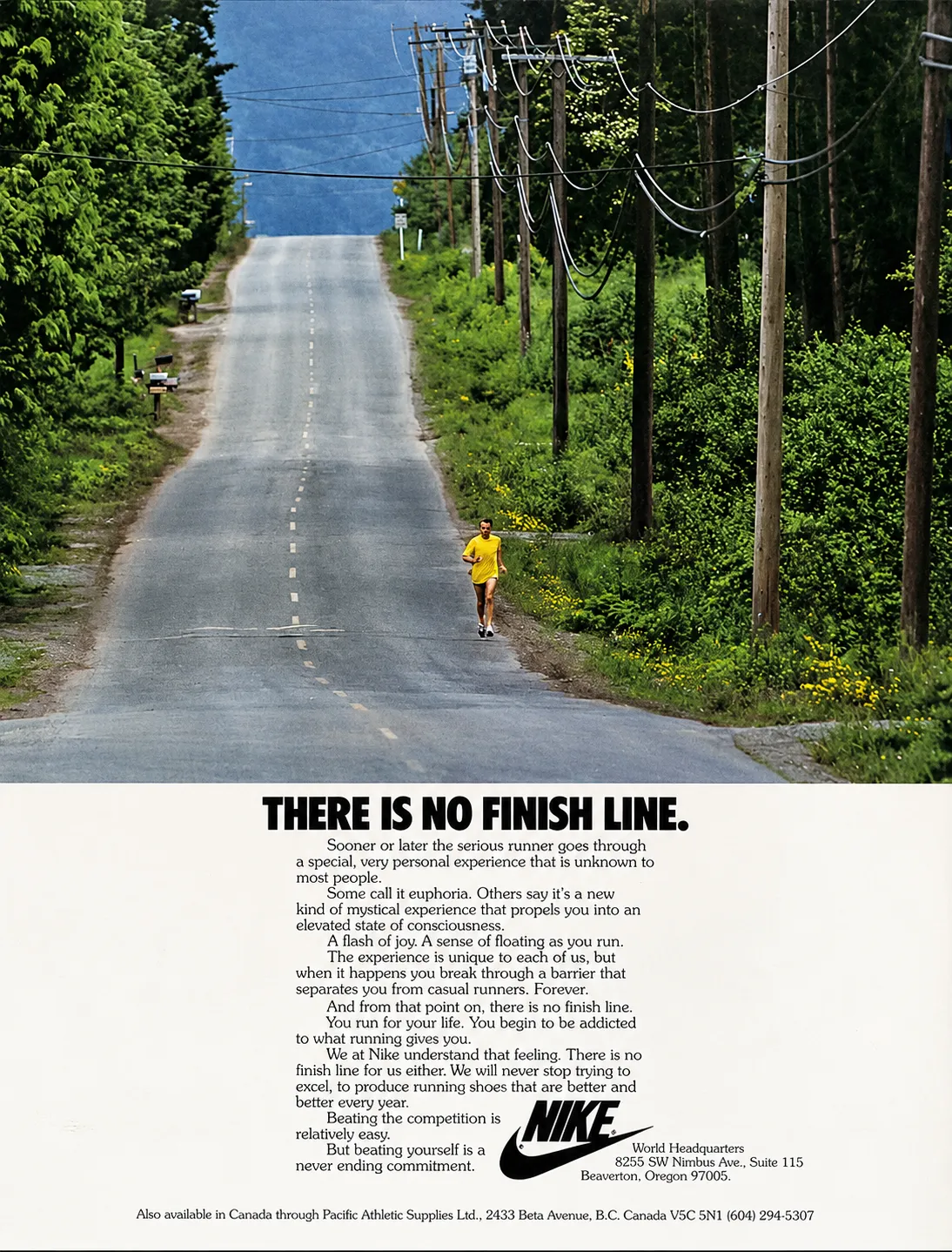
Nike, "There Is No Finish Line," 1977. John Brown & Partners; photograph by Bob Peterson.
The copy underneath spoke about the strange point at which running becomes something more than exercise. Nike told serious runners that it understood the feeling that kept them running even when there was no race left to win.
Then something unexpected happened. People wrote to Nike. They were not asking about the weight of a shoe or a new piece of technology. They were telling Nike that the advertisement understood them, and some wanted copies they could hang on their walls.
Nike had never planned to sell posters. But the demand was there, the company began producing them, and within three or four years its poster business had grown into a multimillion-dollar operation.
Nike had started with an advertising slot and no product to launch. It ended up with consumers asking the company to create a product from the advertisement itself.
More importantly, Nike had stumbled onto something that would eventually become central to the company it built. Demand does not always begin by putting the product closer to the customer. Sometimes it begins by giving the customer a reason to come looking for you.
Nearly fifty years later, Nike is having to confront that distinction again.
The temptation to own the transaction
Telling demand creation from demand capture is easy when you have nothing to sell. It gets harder when you have a great deal to sell, and somebody else is ringing up the sale.
By the late 2010s, Nike had become one of the most recognized brands in the world. Millions of consumers already knew the Swoosh. Its shoes sat inside Foot Locker, department stores, sporting-goods chains and thousands of other retailers.
That reach had helped build Nike. It also meant sharing the transaction.
When someone bought a pair of Nike shoes from a retailer, Nike made the product and created much of the demand, but someone else controlled the shelf, the checkout and much of the customer relationship. The retailer also kept its share of the economics.
The alternative was increasingly obvious. Sell the same customer the shoe through Nike.com, the Nike app or a Nike store, and Nike could control much more of the experience. It could decide how the product was presented. It could know who bought it. It could bring that customer back directly. And instead of selling the shoe to a retailer at a wholesale price, Nike could capture the retail sale itself.
For a company with Nike’s brand recognition, that was a powerful proposition.
The shift had already begun by 2017. Nike called its strategy the Consumer Direct Offense. One of its three ambitions was straightforward: 2X Direct.
Then came 2020. Stores closed around the world and consumers moved online almost overnight. In Nike’s fiscal fourth quarter, digital sales jumped 75 percent and reached roughly 30 percent of total revenue. What had looked like the future suddenly looked like the present.
Nike accelerated. Its new Consumer Direct Acceleration strategy promised a more digital, more personalized and more profitable relationship with consumers. Nike began reducing what it called “undifferentiated” wholesale accounts and directing more product toward Nike Direct and a smaller group of strategic retail partners.
The margin looked better, then demand became the problem
For a while, Nike’s bet appeared to work.
By fiscal 2022, Nike Direct revenue had grown to $18.7 billion, up 14 percent in a year when wholesale revenue declined slightly. Gross margin reached 46.0 percent, 120 basis points higher than the year before. Nike itself pointed to margin expansion in its Direct business as one of the reasons.
This was exactly what the strategy was supposed to do. Sell more directly. Keep more of the transaction. Build a larger membership base. Reduce dependence on retailers. Convert Nike’s enormous existing demand into better economics.
The problem was not that this logic was wrong. It answered a different question. It answered how Nike could make more money from someone who already wanted Nike. It did not answer how Nike would keep making people want Nike.
For several years, that distinction was easy to miss. Revenue kept growing. Nike crossed $50 billion in annual sales. Direct became a much larger part of the business. The company had more consumer data, more digital relationships and greater control over how its products reached customers.
Then the signals started changing.
By fiscal 2024, Nike’s revenue had essentially stopped growing at $51.4 billion. Nike Digital declined. In the final quarter, Nike Direct fell while wholesale grew.
A year later the deterioration was harder to ignore. Nike Brand revenue fell 9 percent, Nike Direct fell 12 percent on a currency-neutral basis, and Nike Digital fell 20 percent. Even wholesale declined, although less sharply.
Eventually the margin followed the demand. Gross margin dropped from 44.6 percent to 42.7 percent in fiscal 2025 as Nike relied more heavily on discounts, dealt with excess and aging inventory, and worked to reset its product portfolio.
That sequence matters. A company can improve the economics of a transaction without improving the health of the demand behind it. Better channel economics make the business look stronger for a while. But if fewer consumers want the product at full price, the problem returns through promotions, inventory and weaker margins.
This is why Nike’s turnaround is more interesting than a DTC-versus-wholesale story. Nike is now reopening wholesale doors, investing again in sport, cutting back on some overextended franchises and trying to rebuild its product pipeline. Distribution is relatively easy to change. The harder question is whether Nike is creating more demand again, and whether that demand is healthy enough to make its way back into margin.
Neither headline number can answer that question
Before looking for the answer in Nike’s results, it is worth knowing what those results can say, because in fiscal 2026 both numbers people reach for were moved by something other than consumers.
Nike, Inc. reported $46,398 million of revenue, flat on the year and down 2 percent currency neutral. Underneath that:
| NIKE Brand, fiscal 2026 | Revenue | Reported | Currency neutral |
|---|---|---|---|
| Sales to wholesale customers | $27,453m | +6% | +4% |
| Sales through NIKE Direct | $17,720m | -6% | -8% |
North America shows the shape more sharply. Revenue rose 5 percent to $20,511 million, but wholesale rose 14 percent while Nike Direct fell 6 percent.
Recall what changes when a shoe moves between those two lines. Sold through Nike’s own store or app, Nike records the retail price. Sold to a wholesale partner, it records the wholesale price, a fraction of it. The shoe, the factory and the customer are identical. Only the number changes.
That cuts both ways, which is what makes the direct-to-consumer years worth rereading. While Nike was shifting volume into Direct, revenue rose partly because the company had moved the till closer to the customer and started booking a markup it used to hand to somebody else. Some of that growth was demand. Some of it was altitude. Fiscal 2026 ran the same machine backwards, and the flat revenue line understates what happened underneath it.
The margin runs the other way. Reported gross margin was 42.9 percent, up 20 basis points, which reads like a company holding its economics steady. Inside it sits $986 million recovered from IEEPA tariffs, an amount large enough to account for the entire improvement and then some. Nike also earns a lower margin on wholesale than on direct, so the mix shift compresses margin by itself, without any customer deciding anything.
Revenue understates, margin overstates, and neither settles the question. Fortunately Nike settles it directly, in a place most consumer companies leave blank. Alongside each segment, it reports how many things it actually sold.
Across the NIKE Brand in fiscal 2026, unit sales of footwear fell 1 percent and unit sales of apparel rose 1 percent. Globally, Nike sold roughly as many products as it had the year before. That is the honest headline, and it is neither the recovery the wholesale growth implies nor the collapse suggested by the fall in Direct.
It also conceals three entirely different situations, which appear only when the same disclosure is read region by region.
| Fiscal 2026, currency neutral | Footwear unit sales | Effect of price on footwear revenue |
|---|---|---|
| North America | +6% | -1 point, channel mix |
| EMEA | -2% | -3 points, higher discounts |
| Greater China | -14% | -1 point, channel and product mix |
Three markets, three different mechanisms. North America sold more shoes. EMEA held its volume roughly flat and paid for it with discounts. Greater China sold substantially fewer shoes without discounting its way out.
Those are demand outcomes. No channel accounting moves them.
Demand returns before the margin does
If the turnaround is working, it should appear earlier and somewhere less obvious: in what consumers choose when Nike stops pushing them toward the purchase.
That makes the composition of Nike’s recent growth more important than the growth itself.
North America is where it is clearest. Footwear unit sales rose 6 percent, and the small decline in average selling price came from channel mix rather than discounting, partially offset by what Nike calls strategic pricing. More pairs of shoes, sold at prices the company chose rather than prices the market forced.
The composition underneath is as interesting as the total. By the second quarter of fiscal 2026, Nike’s running business was growing at a high-double-digit rate across its own stores, digital channels and wholesale partners, while the classic footwear franchises the company had depended on for years were declining by approximately 20 percent.
That difference matters. Nike could have restored revenue simply by putting more Air Force 1s, Dunks and Jordans back into more stores and promoting them harder. Instead, the strongest growth is appearing in categories where Nike has been rebuilding product, while the franchises it could have leaned on are the ones being allowed to shrink.
There are other signals in the same direction. Nike ran fewer promotional days on Nike.com, markdown rates came down, and a greater share of demand came at full price. When Nike launched the Mind 1, the shoe sold out across geographies, and more than two million consumers signed up to be notified about future Mind products, enough for the company to double production for the following two seasons.
None of that proves Nike has restored its brand. But a company selling 6 percent more shoes with fewer promotional days is describing something different from a company holding revenue together with markdowns.
A sale created by a 30 percent discount and a sale created because a consumer searched for a new Nike shoe both appear as revenue. Economically they are very different transactions. The second one gives Nike something the first does not: room to charge full price, confidence to produce more inventory and leverage when deciding how widely the product should be distributed.
That is how demand eventually reaches margin.
The beginnings of that sequence are visible in North America. Wholesale revenue has recovered. Running is growing across channels. Newer products are beginning to replace some of the dependence on old franchises. Promotional intensity has eased.
So the useful question is not yet whether Nike’s turnaround has succeeded. It is whether consumer pull is beginning to replace the push that Nike relied on when demand weakened.
In parts of the business, the answer appears to be yes. In one of Nike’s largest markets, it is much harder to see.
Two markets moving in opposite directions
Greater China continued to decline even as some of the same performance categories improved elsewhere. And that makes Nike’s next decision there unusually interesting, because just as the company is rediscovering how valuable wider distribution can be when demand is recovering, Nike is preparing to restrict parts of its online distribution in China.
North America remains the engine, at about $20.5 billion of Nike Brand revenue in fiscal 2026, roughly 45 percent of the total, growing 5 percent.
Greater China is smaller but still significant at $5,847 million, roughly 13 percent of Nike Brand revenue. More importantly, it used to be much larger. The segment has fallen from $7,545 million in fiscal 2024, a decline of $1.7 billion in two years, including 13 percent currency neutral this year.
In North America, Nike is expanding access. It has reset more than 1,300 running spaces, from Dick’s to Nordstrom to independents like Heartbreak Hill, and launched a Nike Brand Store on Amazon that the company says is producing stronger engagement and sales than expected. North American wholesale revenue grew 14 percent in fiscal 2026. The logic is simple: if Nike is making products consumers want again, more high-quality distribution can amplify that demand.
China is moving in the opposite direction. From January 2027, Nike’s China digital marketplace will center on its own flagship experiences on Tmall, JD.com and Douyin, alongside Nike.com.cn and the Nike App, and partner-operated online stores will transition away from selling Nike with limited exceptions. Nike’s stated objective is to reduce fragmentation rather than access, on the argument that the same product has been appearing through too many sellers at different prices, assortments and standards of presentation.
So one market is getting more distribution while the other is getting less.
Both can be consistent with the same principle. Distribution creates value when it adds demand. It destroys value when it only adds another place to complete the same transaction.
Nike itself does not frame these as two strategies. Its 10-K describes one program running at different speeds:
“Our reportable operating segments are at different stages of progress… North America has made the most progress against these actions, while Greater China and Converse will take more time.”
That claim is worth testing, because a market that is merely behind should look like the market that is ahead, only earlier. Same shape, later date.
North America’s shape is a reallocation. Direct fell 6 percent, wholesale rose 14 percent, the segment grew 5 percent, and footwear units rose 6 percent. Demand moved between channels and grew while it moved.
Greater China’s shape is not that. Wholesale fell 14 percent, Direct fell 12 percent, digital fell 29 percent and comparable store sales fell 6 percent. No channel absorbed anything. Every route to the customer contracted at once.
Part of that is Nike’s own doing, and the company says so. It attributes the wholesale decline to “our actions to prioritize marketplace health,” and it is separately repositioning digital as a full-price platform, which mechanically strips out discounted volume. A company doing both should expect wholesale and digital to fall, and that concession is owed.
The unit line is what none of it explains. Footwear unit sales in Greater China fell 14 percent and apparel units fell 8 percent, while pricing held roughly flat, with lower discounts working in Nike’s favor rather than against it. Nike sold materially fewer products to Chinese consumers, and it did not do so while trading volume for price. It simply sold less.
That is the difference between the two markets, and it is not a difference of timing. In North America, Nike sold 6 percent more pairs of shoes. In Greater China it sold 14 percent fewer. A market that is merely behind sells fewer units later. It does not sell them in the opposite direction.
China may be a different kind of demand problem
Simplifying online distribution in China may improve pricing, presentation and control. It may not solve the harder problem.
China has changed faster than Nike has. Local competitors such as Anta and Li Ning have become stronger. Consumers have more choices. Digital commerce moves quickly. And products, campaigns and trends that work globally do not automatically create the same demand in Shanghai or Chengdu.
Nike now acknowledges that it needs to become more local. In 2026 it appointed its first ever Greater China Vice President of Local Product Creation, a role dedicated to products designed, developed and made in China for Chinese consumers.
The timing is revealing, because Adidas has been moving that way for years. Its Greater China business grew 13 percent on a currency-neutral basis in 2025, with double-digit growth in both performance and lifestyle. Behind that recovery is a deliberately local operating model: a creation center in Shanghai, local teams with authority to adapt global products and assortments, and the vast majority of products sold in China produced within the market.
The advantage is not that Adidas looks more Chinese. It is that it can learn faster. A local team can see a preference emerging, design around it, source closer to the market, adjust orders and replenish successful products without waiting for every decision to travel through a global organization.
Starbucks reached a similar conclusion from a different category. In April 2026 it closed a joint venture handing 60 percent of its Chinese retail operation to Boyu Capital, a local investment firm, keeping 40 percent and continuing to own and license the brand and intellectual property. Starbucks did not exit China. It decided that owning the brand and owning every part of the operating system were no longer the same thing.
Nike is taking more control over who can sell its products online, at a moment when other global brands are moving product creation and operating ownership closer to the market.
There may be no contradiction if Nike does both. Fewer duplicated storefronts could protect pricing and presentation, while local product creation could create the demand those storefronts were failing to generate. But the order matters. Distribution can amplify relevance. It cannot manufacture it. If Chinese consumers increasingly prefer products from Adidas, Anta or Li Ning, making Nike’s digital marketplace cleaner will not by itself bring them back.
There is one more signal in what Nike expects next. Management has said its actions in Greater China will remain a revenue headwind through fiscal 2027, while profitability “should bottom sooner.” Read plainly, that is a company expecting to fix the economics of a market roughly a year before it fixes the demand in it.
Management is putting money behind the diagnosis
The obvious conclusion from a company under this much pressure would be that it has been starving the brand. The filings do not support it.
Nike is one of the few large companies that does not call this advertising. Its income statement carries a line named Demand creation expense, defined as brand marketing, which covers advertising, media, digital marketing and brand events, together with sports marketing, which covers endorsement contracts, complimentary product and sports events.
It is a useful line to have during an argument about whether a company still knows how to make people want things, because it is the one number on the statement that is entirely a choice. Revenue is an outcome. Margin is partly arithmetic. Demand creation expense is a decision somebody makes on purpose.
| Fiscal year | Revenue | Demand creation expense | % of revenue |
|---|---|---|---|
| 2023 | $51,217m | $4,060m | 7.9% |
| 2024 | $51,362m | $4,285m | 8.3% |
| 2025 | $46,309m | $4,689m | 10.1% |
| 2026 | $46,398m | $4,754m | 10.2% |
The decision has been to spend more. The line is up 17 percent in dollars since fiscal 2023 while revenue fell 9 percent, and at 10.2 percent of revenue it runs well above the 7.9 percent of the peak revenue year. Part of that ratio is the denominator falling rather than the numerator rising, but the numerator did rise.
Within it, the mix has moved toward sports marketing and away from brand marketing, though the comparison runs against a year containing a summer of major sports events, so that shift should not be over-read from a single year.
The more revealing cut is by market, because the group total conceals a choice.
| Fiscal 2026 | Footwear unit sales | Demand creation expense |
|---|---|---|
| North America | +6% | +6% |
| EMEA | -2% | +5% |
| Greater China | -14% | -14% |
Nike increased demand creation spending 6 percent in the market where it sold 6 percent more shoes, and cut it 14 percent in the market where it sold 14 percent fewer. In Greater China the reduction came, in the company’s own words, “primarily due to lower brand marketing expense.”
There is a defensible case for that. Pouring brand spending into a market while still clearing inventory and resetting a fragmented marketplace can be waste, and Nike has said Greater China will take longer. Spending behind momentum is ordinary commercial discipline.
It is also the precise inverse of what the company did in 1977, and it sits awkwardly beside Nike’s own diagnosis of that market. Nike says China needs to become more locally relevant. Relevance is what brand marketing is for, and brand marketing is the line that came down.
Willingness to spend is not in question, and that is one of the clearest reasons to take this turnaround seriously. Management is funding its own diagnosis rather than describing it, in a year when the cash to do so was harder to find.
Whether that investment converts into demand is a separate question, and so far it has been answered in one category. Running is growing. Everywhere else it is still a bet.
Is this simply early?
The strongest objection to all of this is that the program is unfinished. Nike is reducing supply of certain franchise models on purpose, clearing inventory through markdowns on purpose, and moving digital away from discounted volume on purpose, with the actions expected to complete by the end of December 2026. Judged against that plan, two hard years are the cost of the reset rather than evidence against it. The objection is not a straw man. It comes from the same filing as everything else here.
It also has evidence behind it. North America is the market furthest along and it is working. Group demand has steadied, with NIKE Brand footwear units down 1 percent and apparel units up 1 percent.
What that reading struggles with is the spread. The program is the same everywhere and the outcomes are not. North America sold 6 percent more pairs of shoes. Greater China sold 14 percent fewer. Converse fell 31 percent in a single year and 44 percent across two, and Jordan Brand is down 19 percent from fiscal 2024.
Demand has stabilized in aggregate. It has not stabilized in the parts of Nike that were only ever desirability. If the reset explained the results, the results would look more alike than that.
Two years is not long for this kind of repair, and Nike’s own timeline still has months left to run. But the test is not complicated. It is whether people go looking for a Nike franchise again. Nothing yet says they have.
Scale does not mean unlimited room
Nike still has something most turnaround companies would envy. It generates more than $46 billion of annual revenue, holds approximately $9 billion of cash and short-term investments, and earns a return on invested capital of 18.7 percent. Its balance sheet gives it time.
Its financial room is narrower than those numbers suggest.
| Fiscal year | Cash from operations | Dividends | Dividends as % of operating cash |
|---|---|---|---|
| 2024 | $7,429m | $2,169m | 29% |
| 2025 | $3,698m | $2,300m | 62% |
| 2026 | $2,868m | $2,407m | 84% |
Operating cash flow has fallen to a third of its fiscal 2024 level in two years. After $684 million of capital expenditure, Nike generated roughly $2.18 billion of free cash flow last year and paid $2.407 billion in dividends. The cash the business generated after investing in itself did not cover the dividend. Nike’s own filing says it without decoration: cash from operations “was more than offset by cash dividends and capital expenditures.”
The dividend rose 5 percent in that year, as it has risen every year for decades. Meanwhile share repurchases fell to $146 million from $2,985 million the year before and $5,480 million in fiscal 2023, and the filing is explicit that this was a decision rather than a drift: “We paused repurchases under this program during the first quarter of fiscal 2026.”
So in the year its cash generation fell hardest, Nike stopped the shareholder return it can switch off at will and increased the one it cannot. A dividend cut at a company with Nike’s record would be read as a statement about the business, which is exactly what makes the dividend the expensive commitment and the buyback the cheap one. The flexibility has been spent. The obligation remains.
None of this puts Nike in financial distress. It has substantial liquidity and access to capital. But turnarounds consume money before they produce it, and rebuilding North America, fixing China and protecting a growing dividend are all competing for the same cash.
Nike has the scale to attempt all three. It has less freedom to get all three wrong.
There is no finish line
It would be easy to conclude that Nike went too far into direct-to-consumer and simply needs wholesale again. That is the wrong lesson.
Nike does not need the most distribution. It needs the right distribution for the demand problem it is trying to solve. In North America that currently means more access, because a runner comparing shoes at Dick’s or a teenager walking into Foot Locker may not have decided on Nike before entering the store. The retailer is not merely completing the transaction; it can influence it. China may require the opposite, if the online marketplace there has become duplication rather than discovery.
The test for both is the same question: does this channel create demand, or does it capture a transaction that would have happened somewhere else?
Underneath it sits the sequence the whole business runs on.
Desirability creates demand. Demand creates pricing power. Pricing power creates margin.
Distribution matters enormously inside that chain. It creates discovery, amplifies demand, improves availability and determines how the economics are shared. What it cannot do is originate the chain. A channel decision moves demand between places. It does not bring it into existence, which is why the argument about direct-to-consumer versus wholesale was never the argument that mattered.
What Nike got wrong was which end of the chain it chose to optimize. It spent years working the margin side of the equation, on how much of each transaction it could keep, and succeeded on its own terms while paying too little attention to the demand side that made those transactions worth having. Better capture cannot survive weaker desire. The margin was never the source of the margin.
Nike has now reversed the emphasis, and the reversal is visible in its own accounts. Demand creation is running at the highest share of revenue in years. Franchise supply is being restricted to rebuild scarcity rather than pushed to fill a quarter. Digital is being repositioned around full price instead of volume. Wholesale partners are being treated as a way to reach consumers rather than as margin to be reclaimed. The company has moved its attention back to the demand side of its own equation, which is the correct side and the harder one.
What remains unsettled is execution, not intent. Judged properly, the turnaround will not announce itself in a quarter of revenue growth, a temporary improvement in gross margin, or the return of wholesale. Those are checkpoints. The earlier signals are whether new products sell without heavy promotion, whether retailers reorder them, whether full-price selling improves, and whether growth begins to come from new franchises rather than another cycle of Dunks and Air Force 1s.
In 1977, with nothing to sell, Nike bought a page it could not fill and spent the money making runners feel understood. The advertisement barely showed the shoe, and people asked to hang it on their walls.
That remains the most useful reminder available to the company.
The finish line was never owning the transaction. It was creating enough demand that everyone wanted to be part of it.
Sources
- NIKE, Inc. FY2026 Form 10-K
- NIKE, Inc. FY2024 Form 10-K
- NIKE, Inc. FY2022 Form 10-K
- NIKE, Inc. Reports Fiscal 2026 Fourth Quarter and Full Year Results
- NIKE Q1 FY2026 earnings call transcript
- NIKE Q2 FY2026 earnings call transcript
- NIKE Q3 FY2026 earnings call transcript
- adidas reports record revenues for 2025, including Greater China results
- Starbucks and Boyu Capital joint venture, Form 8-K exhibit
- Scott Reames on Nike’s 1977 “There Is No Finish Line” campaign, Marketing History