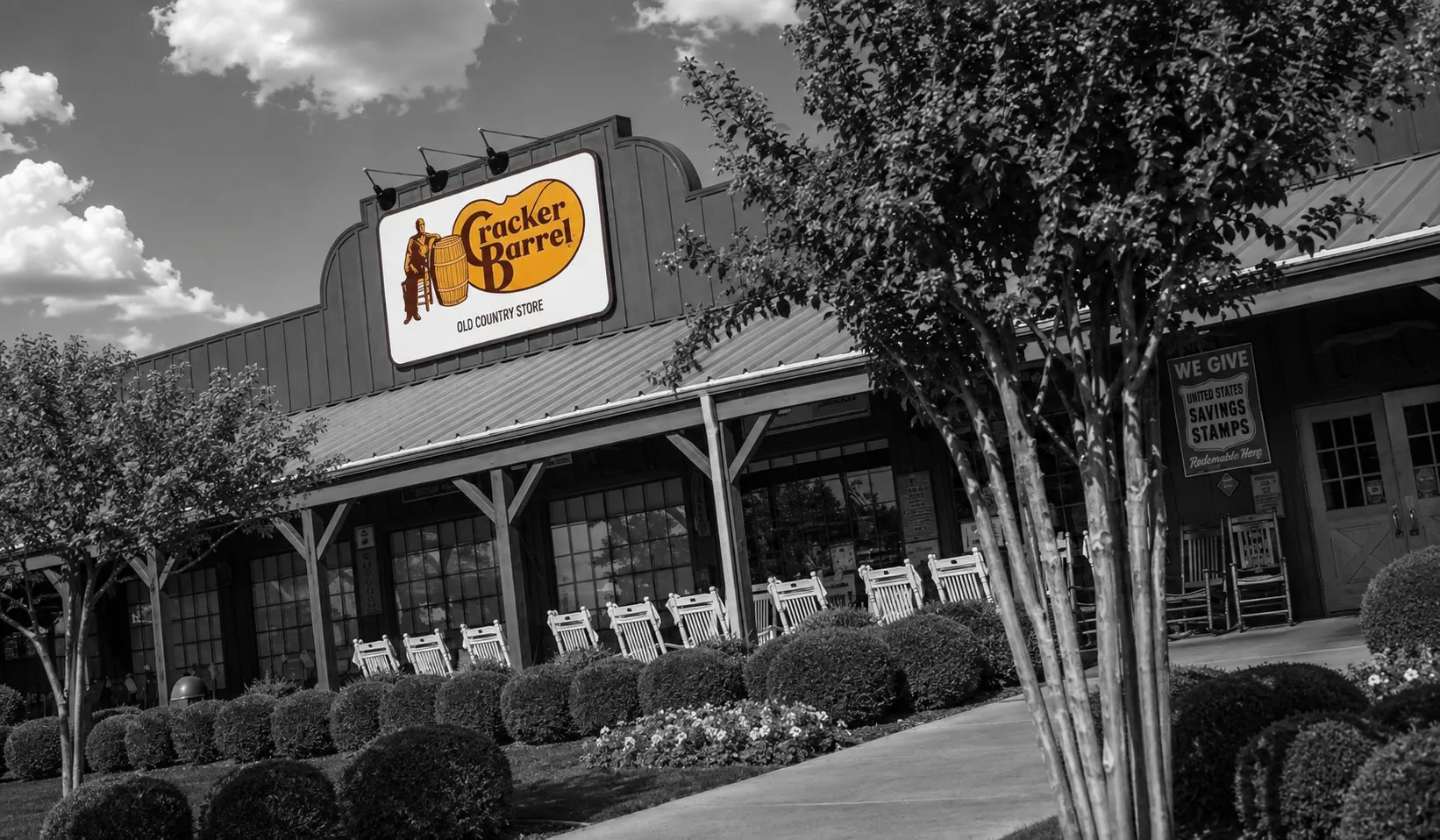
For a week in August 2025, Cracker Barrel’s most visible problem was a logo. The company introduced a simplified mark, customers objected, and the familiar Old Timer returned. It was a swift response to a loud reaction. It also showed how easily a mature brand can focus attention on the part of recovery that people can see.
The harder work happens inside the customer’s decision. A restaurant earns a visit when it fits an occasion, offers a compelling exchange of time and money, and delivers the experience well enough to be chosen again. Identity can shape that decision. Loyalty can encourage it. Neither tool can carry the full weight of food, value, service, atmosphere, and convenience.
That distinction matters well beyond Cracker Barrel. Turnarounds produce plenty of activity: a new campaign, refreshed stores, a rewards program, a portfolio sale, a new chief executive. The commercial test is whether those actions give people a stronger reason to choose the business more often, and whether the operating model can serve those visits at a cost that leaves durable profit and cash.
Cracker Barrel has yet to show that full chain working. Its filings show a multi-year loss of visits that became much more severe in fiscal 2026. Its July actions created financial room and changed accountability. The customer recovery still has to be demonstrated.
Demand Begins With An Occasion
Cracker Barrel does not compete only with other family-dining chains. It competes for occasions: breakfast away from home, a road-trip stop, a familiar family meal, or an easy alternative to cooking. Each occasion begins with a choice. The customer weighs relevance, expected experience, price, time, and all the other available ways to solve the same need.
Demand becomes durable when that choice repeats. Trial brings someone through the door once. A reliable proposition brings the person back. Enough repeat visits across enough customers become traffic, and traffic gives a restaurant system the volume over which to spread store labor, occupancy, utilities, and other costs.
This is why traffic carries more strategic information than sales alone. Sales can rise because customers visit more often, spend more each time, or both. A larger check can support revenue while visit frequency weakens underneath it. For a mature chain with hundreds of existing restaurants, that difference is fundamental. Price can lift the value of a transaction. It cannot manufacture the transaction itself.
The available evidence does not tell us which part of Cracker Barrel’s proposition caused individual guests to visit less often. Menu relevance, value, service, atmosphere, brand decisions, and macroeconomic pressure are all plausible contributors. It does tell us the customer behavior the recovery must reverse: fewer visits.
A Multi-Year Pattern, Not A Single Miss
Cracker Barrel’s comparable guest traffic declined in fiscal 2023, fiscal 2024, and fiscal 2025. In two of those years, average-check growth helped produce positive comparable restaurant sales. The revenue line therefore looked more resilient than the underlying visit pattern.
The recent decline follows a longer capital-allocation history. From fiscal 2011 through fiscal 2025, Cracker Barrel reported $1.937 billion in dividends and share repurchases, about $1.07 returned to shareholders for every $1.00 spent acquiring property, plant, and equipment. That comparison does not prove underinvestment, but it sharpens the question of how a company-owned estate was renewed while cash was also returned to shareholders.
The gap widened in fiscal 2026. During the first nine months, comparable guest traffic fell 8.1% while average check rose 3.2%. Comparable restaurant sales declined 4.9%. The strategic signal is straightforward: customers paid more per visit, but there were far fewer visits to price.
The financial results show why the distinction matters. Over the same nine months, Cracker Barrel reported an operating loss of $24.1 million on $2.40 billion of revenue, an operating margin of approximately negative 1.0%. Operating cash flow fell to $92.5 million from $116.7 million a year earlier. Those numbers support the customer story. They show the economic consequence of a restaurant estate losing volume while still carrying the costs of operating its stores.
Macroeconomic pressure belongs in the explanation. Management cited it, and restaurant customers were making real affordability choices. The evidence does not support using it as the whole explanation. In Darden’s fiscal 2026, guest counts rose at Olive Garden, LongHorn Steakhouse, and its group of other casual brands. Chipotle, a more distant comparison, recorded positive transaction growth in its fiscal second quarter of 2026.
Neither company is a direct benchmark. Darden offers a closer full-service category check, while Chipotle has different occasions and economics. Together they establish a useful boundary: difficult consumer conditions did not force traffic to fall everywhere. Cracker Barrel’s scale and persistence of decline therefore require a company-specific demand response.
Company Ownership Raises The Stakes
Cracker Barrel operated 657 company-owned locations at the end of its fiscal third quarter. That structure gives management direct control over the experience. It can change menus, service routines, staffing, maintenance, and store investment across the system. It also concentrates the economics.
When store demand is healthy, each additional visit contributes revenue while many occupancy and management costs move more slowly. The result can be strong conversion of sales into restaurant profit and cash. Chipotle illustrates the upside rather than setting a Cracker Barrel target. Its fiscal second-quarter transactions rose 1.0%, and restaurant-level operating margin was approximately 25.2%, even after declining from the prior year under cost pressure.
The same structure works in reverse. When traffic falls, labor cannot always be removed without damaging service, rent remains due, and the physical estate still needs investment. Lower volume then spreads those costs across fewer transactions. Margin can deteriorate faster than revenue, leaving less internally generated cash available to improve the experience that demand recovery may require.
This creates the central strategic tension. Management needs to invest in a clearer and more reliable reason to visit while current demand makes that investment harder to fund. Company ownership provides the control needed to fix the experience and places the cost of doing so on the same balance sheet.
What The July Actions Changed
Cracker Barrel’s July 2026 decisions addressed real constraints. A sale-leaseback generated approximately $77 million, which the company used to repay revolving debt. The company exited Maple Street Biscuit Company, a small non-core business representing less than 2% of annual revenue. One week later, David Deno replaced Julie Masino as chief executive.
These actions created financial capacity, narrowed management focus, and changed leadership. They also left the customer mechanism unresolved. The sale-leaseback added approximately $5.7 million of initial annual rent plus triple-net obligations. It brought cash forward by exchanging property ownership for recurring occupancy costs. That can provide room to fund a turnaround. It raises the importance of converting future visits into enough cash to carry the added obligations.
Early fiscal fourth-quarter comparable restaurant sales improved to a decline of approximately 2.5%. That is an encouraging signal, with an important gap: Cracker Barrel did not disclose the traffic and average-check components. The company has shown that sales pressure moderated. It has yet to show that more people are choosing to visit.
Loyalty Can Strengthen A Working Proposition
Cracker Barrel Rewards gives the company a better view of identified customers and a channel for encouraging repeat behavior. That is valuable. Transaction history and linked feedback can help management see visit patterns, test offers, and learn where the experience falls short.
The program’s role should be judged by incrementality. Membership and tracked sales show adoption and visibility. The recovery question is whether the program changes behavior: more visits from existing guests, renewed visits from lapsed guests, and profitable demand that would not have occurred without the intervention.
Loyalty works best as an amplifier. When the core proposition is compelling, it can reduce friction and help turn satisfaction into habit. When the proposition is weak or inconsistently delivered, rewards may subsidize visits that would have happened anyway or encourage a temporary response. Better customer data is an input to demand strategy. The output must still appear in behavior.
What Cracker Barrel Can Teach Brands About Demand Creation
Cracker Barrel’s recovery should be judged as a sequence rather than a list of initiatives. First, the company must sharpen the occasions and customers for which it offers a distinctive reason to visit. Next, its restaurants must deliver that promise consistently enough to earn repetition. Then traffic, store economics, margin, and cash should improve together over multiple periods.
That sequence gives management and investors a more demanding scorecard. Comparable sales should be decomposed into traffic and check. Loyalty should be measured through incremental frequency and reactivation. Store investment should connect to guest response and restaurant returns. Financing actions should be evaluated by the operating progress they enable and the obligations they add.
The broader lesson is simple. Mature brands rarely recover through the visibility of change. They recover by becoming easier to choose, worth repeating, and economically sound to deliver. Cracker Barrel has created some room to act. Its next proof belongs in the customer’s return.
Sources
The evidence does not establish the dominant reason individual customers reduced visits. Darden and Chipotle are bounded illustrations, not direct performance benchmarks. The sale-leaseback is treated as financing capacity with added obligations, not evidence of operating recovery.